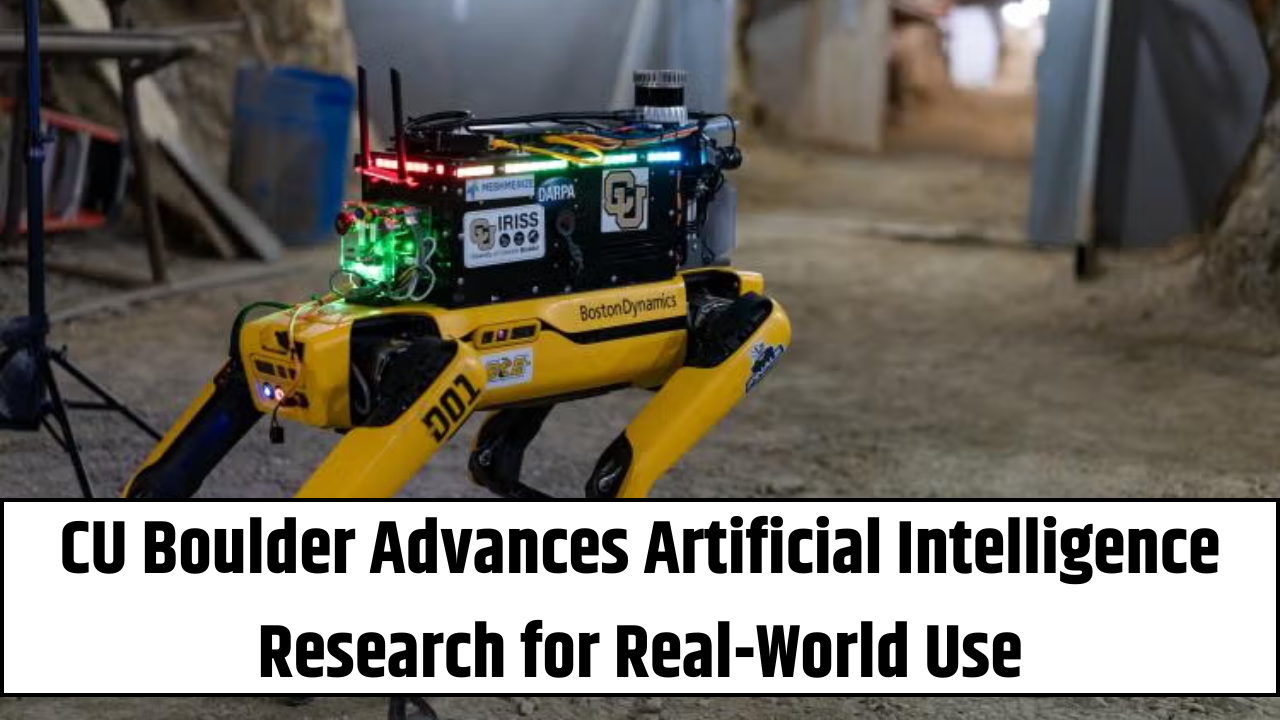
Deep beneath the surface of Colorado, inside a dark and unstable tunnel filled with fallen rock, a robot inches forward where no human rescuer safely could. Its sensors scan fractured ceilings and shifting debris, calculating risk in real time before moving deeper into the unknown. Somewhere ahead, trapped survivors could be waiting. This scene is not science fiction—it reflects the kind of artificial intelligence research underway at the University of Colorado Boulder.
Across the CU Boulder campus, researchers from the College of Engineering and Applied Sciences are pushing the boundaries of AI by building systems designed to work alongside people, not replace them. From autonomous robots navigating collapsed structures to algorithms that extract life-saving insights from medical records, the university’s AI research spans emergency response, space exploration, healthcare, education, environmental monitoring and accessibility.
At the heart of CU Boulder’s robotics efforts is Sean Humbert, professor of mechanical engineering and director of the Robotics Program. His lab focuses on autonomous and bio-inspired systems that can operate in extreme environments where human presence is either impossible or dangerously risky. These machines must process streams of sensor data in fractions of a second, reacting to unpredictable conditions in places such as contaminated disaster zones, deep-sea trenches or collapsed buildings.
Also Read – USF School of Information Promotes Graduate Intelligence Programs at Ole Miss Recruitment Fair
Humbert and his colleagues Christoffer Heckman and Eric Frew recently put their technology to the test during the DARPA Subterranean Challenge, a competition that required robots to explore complex underground environments with no GPS, no maps and limited communication. Real-world failures—from navigation breakdowns to hardware malfunctions—provided invaluable lessons that no laboratory simulation could replicate. That trial-and-error process, Humbert emphasizes, is essential for building rescue robots that can be trusted when lives are on the line.
Heckman, a professor of computer science, is also exploring how language-based AI can enhance robotic understanding. Partnering with the Army Research Laboratory, his team is adapting vision-language models similar to those behind ChatGPT to help robots interpret human instructions that rely on context. Commands like “check the backpack at the back of the building” require spatial awareness and situational reasoning—capabilities that remain challenging for machines but are central to effective human-robot collaboration.
While some researchers rely on data-driven learning, others take a more formal approach to safety. Morteza Lahijanian, associate professor of aerospace engineering sciences, develops AI systems grounded in mathematical verification. Rather than learning solely from experience, his methods use logic-based reasoning to ensure that autonomous systems behave safely before they are ever deployed. This hybrid approach blends intuition with provable guarantees.
Lahijanian’s work is especially critical in space exploration, where autonomous spacecraft may need to dock with satellites or space stations without human intervention. With communication delays and high mission costs, failure is not an option. His verification techniques help ensure that AI systems can handle unforeseen scenarios in environments far beyond Earth.
Also Read – AU Announces New PhD Program in Intelligence, Defense, and Cybersecurity
Closer to home, other CU Boulder researchers are focused on improving how robots and humans work together. Brad Hayes, associate professor of computer science, integrates machine learning techniques such as explainable AI, reinforcement learning and imitation learning with insights from psychology and robotics. His goal is to create intelligent systems that can adapt to human preferences, explain their decisions and support teamwork rather than hinder it.
Alessandro Roncone, assistant professor of computer science and associate director of the Robotics Program, takes a similarly human-centered approach. His research examines how robots can function as true teammates by understanding human goals and adjusting their behavior accordingly. Questions such as when a robot should intervene, how it should express uncertainty, or how much assistance is too much vary from person to person. Roncone’s work highlights that effective collaboration depends as much on understanding human personalities as on technical performance.
Beyond robotics, CU Boulder researchers are tackling the challenge of language understanding. James H. Martin, professor of computer science and faculty fellow at the Institute of Cognitive Science, studies how machines interpret meaning in human language. Despite the rise of large language models, ambiguity remains a major obstacle. Martin’s NIH-supported research mines electronic medical records to uncover temporal and causal patterns that can improve patient care. Through the NSF-funded AI Institute for Student-AI Teaming, he is also working on systems that analyze classroom dialogue to enhance STEM education.
Maria Pacheco, assistant professor of computer science, focuses on bridging a key gap in language models: access to reliable knowledge. While large language models excel at generating text, they struggle when they need information beyond their training data or must provide transparent explanations. Pacheco’s work integrates structured knowledge sources with language models to create more trustworthy systems for real-world applications.
Seeing, too, remains a challenge for AI. Danna Gurari, assistant professor of computer science, develops systems that go beyond object recognition to produce rich spatial descriptions of images. Designed with input from people with visual impairments, her work enables AI to guide users through environments by describing layouts and spatial relationships without overwhelming them with unnecessary detail.
Education and accessibility also shape CU Boulder’s AI efforts. Associate professor Tom Yeh’s “AI by Hand” project uses hand-drawn illustrations to explain deep learning concepts, making complex architectures more intuitive. His unified framework for visualizing neural networks helps learners compare and build models, and the project’s global following demonstrates the demand for human-centered AI education.
Also Read – Sorrell College Introduces New Artificial Intelligence Center for Business Innovation
Environmental monitoring is another major focus. Esther Rolf, assistant professor of computer science, develops machine learning systems that compress massive volumes of satellite data into usable representations of Earth’s surface. Her research has already uncovered previously undetected artisanal mining activity in Sub-Saharan Africa, demonstrating how geospatial AI can reveal hidden environmental changes.
As AI becomes increasingly embedded in daily life, CU Boulder researchers are addressing not only technical performance but also ethics, transparency and trust. Their work emphasizes systems that enhance human decision-making while respecting human agency.
From disaster response robots to medical analysis tools and environmental monitoring systems, CU Boulder’s AI research reflects a shared goal: building intelligent technologies that extend human capability while keeping people firmly in control.