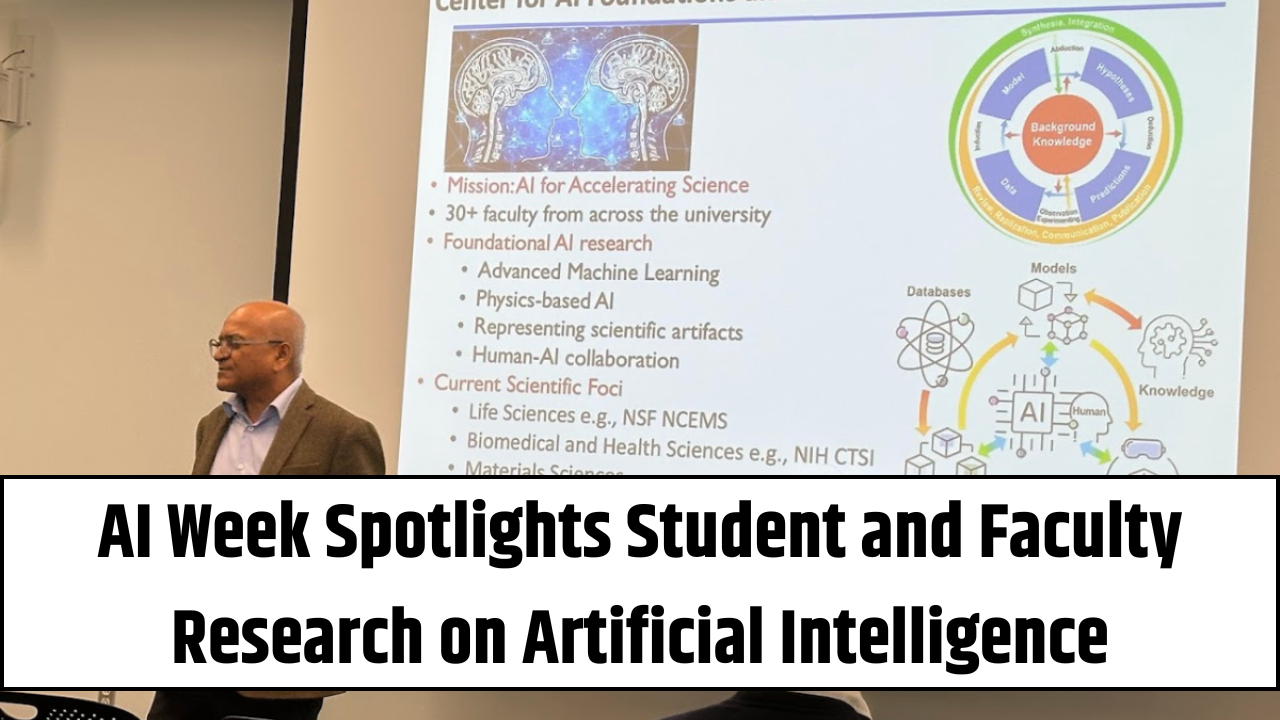
UNIVERSITY PARK, Pa. — Penn State’s annual AI Week highlighted the university’s expanding research, creativity and collaboration in artificial intelligence, with a particular emphasis on how AI tools and systems are shaping both K–12 and higher education.
Held April 14–17, the event brought together faculty, staff and students for a series of panels, research showcases, hands-on workshops and a student poster session. AI Week spotlighted the breadth of AI innovation across Penn State, from scientific research and career preparation to creative expression and classroom applications.
“AI Week brought faculty, staff and students together to further build and strengthen the AI community at Penn State,” said Mehrdad Mahdavi, director of the Penn State AI Hub and associate professor. “The event showcased how AI can accelerate research, support career readiness, enable creative assistants and enhance teaching and learning. We hope these conversations lead to new collaborations across the university.”
A centerpiece of the week was the student poster session, which featured more than 60 research projects exploring AI and machine learning across a wide range of disciplines. Topics included AI-driven approaches to preventing all-terrain vehicle rollovers, optimizing mushroom-picking strategies, developing empathetic conversational models for mental health, and examining student perspectives on responsible AI use.
Also Read – CU Boulder Advances Artificial Intelligence Research for Real-World Use
Undergraduate and graduate students, along with faculty researchers, presented their work to a judging panel. Six presenters received awards:
- First place ($300): Samarth Khanna, second-year doctoral student in the College of Information Sciences and Technology, for “Distributive Fairness in Large Language Models: Evaluating Alignment with Human Values.”
- Second place ($250): Kanguri Han, second-year doctoral student in the Department of Agricultural and Biological Engineering, for “Vision Apple Quality Assessment System for Selective Robotic Harvesting in Complex Orchard Environment.”
- Third place ($150): Suhas Bettapalli Nagaraj, fourth-year doctoral student in the College of Information Sciences and Technology, for “Generative AI for Efficient and Empathetic Conversational Models in Mental Health.”
Three honorable mention awards of $100 each were presented to Matthew Poska, an informatics doctoral student; Sohrab Sheikh Sofla, an electrical engineering doctoral student; and Waquar Kaleem, a doctoral student in industrial and manufacturing engineering.
“Presenting my work on fair decision-making in economic contexts allowed me to connect with others exploring fairness in AI and opened the door to potential collaborations,” Khanna said.
Bettapalli Nagaraj’s research focuses on developing empathetic AI tools for mental health in collaboration with clinicians at Emory University and the Georgia Institute of Technology. His work includes trauma-specific therapy simulations, lightweight AI models for therapist training, and an audio-based system capable of evaluating therapy sessions without relying on transcripts.
“It’s important to raise awareness about AI’s capabilities and how it can be used for social good,” he said.
Panels throughout AI Week featured Penn State researchers from the Center for Artificial Foundations and Scientific Applications (CENSAI) and the Center for Artificial Intelligence Foundations and Engineered Systems (CAFE). Faculty discussed real-world AI applications in areas such as weather prediction, biology, transportation and building infrastructure.
“AI at Penn State is vibrant and growing,” said Vijay Narayanan, associate dean for innovation and director of CAFE. “The depth and breadth of research showcased during AI Week demonstrated the strength of this community, from theoretical advances to technology translation.”
The final day of the event focused on AI in K–12 education and was hosted by the Penn State Center for Science and the Schools (CSATS). Workshops addressed topics such as AI policy and guidelines for education, career pathways, classroom integration, prompt engineering, conservation applications and avoiding misuse of AI tools.
“K–12 day demonstrated the powerful research translation and broader impacts of AI through CSATS and our researchers,” said Jeff Remington, CSATS outreach liaison. “It significantly elevated the reach of their work.”
AI Week also explored AI’s role in the arts. Betsy Campbell, associate teaching professor in the College of Information Sciences and Technology and Fulbright Specialist in AI and Society, coordinated several creative activities, including a human-robot dance performance and a visual art gallery examining AI’s societal impact.
Also Read – USF School of Information Promotes Graduate Intelligence Programs at Ole Miss Recruitment Fair
“This approach to exploring the frontiers of human-robot interaction is unique to Penn State,” Campbell said during the April 17 “Post-human Performance: An AI-enabled Dance Recital.”
Students used AI tools to choreograph a three-minute dance and then programmed a robot to perform alongside them as a true partner rather than a prop.
“AI is often portrayed negatively,” said Gabe Selan, a senior industrial engineering major who participated in the performance. “This gave us an opportunity to show what AI can do creatively and help reduce that stigma.”
Kait Martin, a third-year enterprise technology integration major, echoed that sentiment. “Embracing AI this way helped us see the human element in the technology,” Martin said. “The possibilities are limitless.”
Additional AI Week highlights included the Nittany AI Alliance’s Nittany AI Challenge awards, which recognized five student teams for developing AI-driven projects focused on social good.
More information and links to recorded virtual sessions are available on the Penn State AI Hub website.