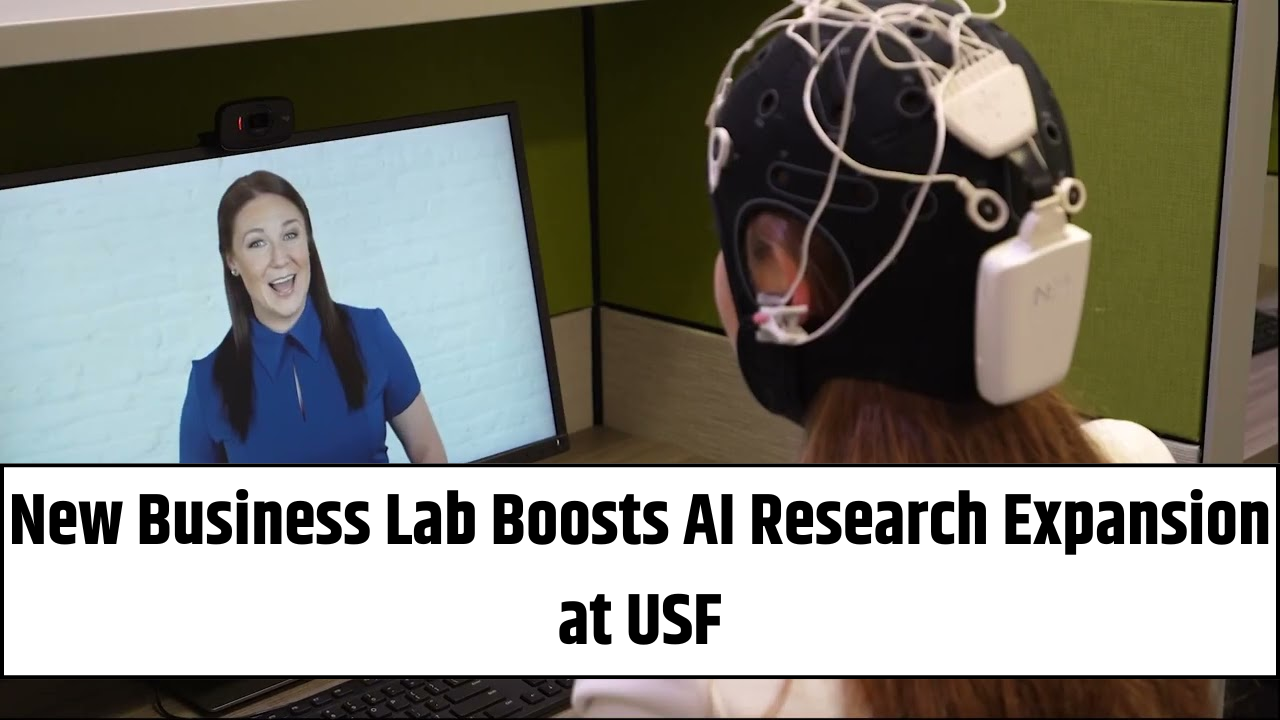
The University of South Florida has unveiled its first lab dedicated exclusively to exploring how artificial intelligence is reshaping business, consumer behavior, and decision-making. Known as the Behavioral AI Lab, the facility is housed within the Center for Marketing and Sales Innovation’s Customer Experience Lab in the Muma College of Business, a nationally recognized hub for consumer-focused research.
The new lab is designed to give students and faculty access to advanced, high-tech tools that allow them to study how people respond to AI-driven interactions in real time.
“AI today is like the internet was in 1995—there will be countless new applications and capabilities in the future,” said Rob Hammond, associate professor and director of the Center for Marketing and Sales Innovation. “We intentionally designed this lab with a wide range of tools so researchers can explore many different questions about AI and human behavior.”
Inside the Behavioral AI Lab
The lab is equipped with sophisticated biometric technology that measures voice tone and word choice, eye movement, facial expressions, stress levels through galvanic skin response, and even electrical activity in the brain. With 20 computer stations, adjustable lighting and sound, and five dedicated interaction rooms, the space supports both in-person and online research focused on human responses to AI systems.
Also Read – UC Davis Launches New Artificial Intelligence Center in Engineering
These capabilities allow researchers to closely examine trust, engagement, emotion, and decision-making—key factors as AI becomes more embedded in marketing, sales, and customer communication.
Studying Trust in AI Avatars
One of the first major research projects conducted in the lab came from Jill Schiefelbein, a recent graduate of USF’s doctor of business administration program. Using the lab’s eye-tracking and facial-expression sensors, Schiefelbein studied whether consumers trust video messages delivered by hyper-realistic AI avatars.
During her dissertation defense, she revealed side-by-side images of herself and her digital avatar, demonstrating just how lifelike the technology has become. Participants watched videos of both Schiefelbein and her avatar while researchers measured their reactions, engagement, and information retention.
Schiefelbein found that transparency plays a critical role in consumer trust. When viewers were told in advance that they would be watching an avatar, most responded positively. However, when the avatar was not disclosed and viewers believed they were watching a real person, reactions turned sharply negative once the truth was revealed. Nearly 85% reported feeling uncomfortable, misled, or even frightened.
“The technology offers businesses an efficient way to scale personalized communication across languages and markets,” Schiefelbein said. “But this research shows that how companies disclose and frame AI use can determine whether consumers trust or reject it.”
Also Read – The Citadel Awarded Grant to Launch AI Healthcare Research Center
Preparing Students for an AI-Driven Future
Hammond said Schiefelbein’s findings highlight both the promise and the challenges AI brings to modern business. While the technology creates new opportunities, it also forces organizations to rethink ethical standards, transparency, and consumer expectations.
“This lab is a critical resource for preparing students for the world they’re entering,” Hammond said. “AI can be a collaborator, a tool, or a competitor. Our goal is to help students not only use AI, but learn how to build responsible, effective solutions to problems that don’t yet exist.”
Students from all three USF campuses can volunteer in the Behavioral AI Lab and conduct research in collaboration with faculty. The Center for Marketing and Sales Innovation operates physical labs in Tampa and St. Petersburg, with remote access available for online data collection and analysis.
Looking ahead, Hammond hopes to expand lab access through new academic programs and interdisciplinary partnerships.
“There are so many unanswered questions about how AI will impact business and society,” he said. “This lab is just the beginning.”