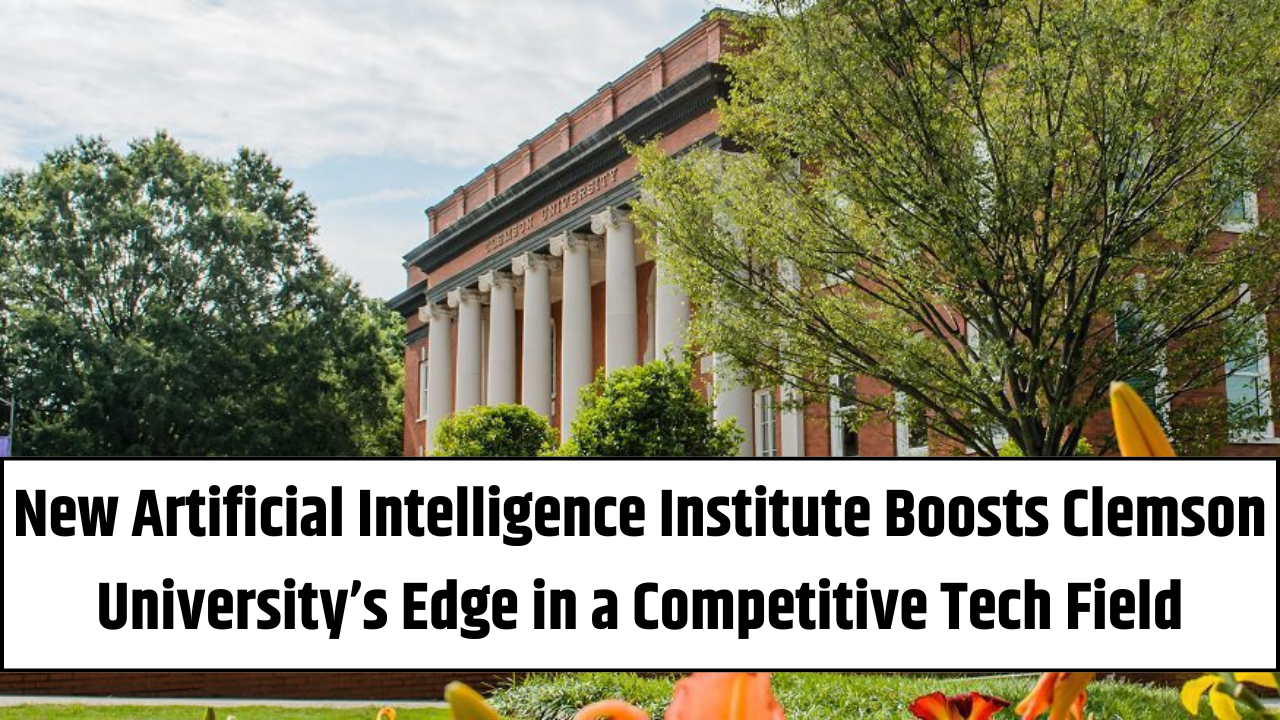
Clemson University is expanding its footprint in artificial intelligence as it prepares students and researchers for a rapidly changing technological landscape. The university has announced the creation of the Clemson Artificial Intelligence Research Institute for Science and Engineering (AIRISE), a new hub designed to unite AI-focused research, education, and workforce development under one umbrella.
Roughly 80 faculty members from across multiple disciplines are collaborating on the launch of AIRISE, reflecting Clemson’s growing commitment to artificial intelligence as a driver of innovation in sectors such as advanced manufacturing, healthcare, transportation, and cybersecurity. While AI research has been underway at Clemson for years, the institute formalizes and amplifies those efforts, allowing researchers to work more strategically and at a larger scale.
The launch comes at a time when artificial intelligence is increasingly viewed as essential to economic growth and national security. Federal initiatives have called for expanded AI training, and major technology companies have invested heavily in dedicated AI laboratories. AIRISE positions Clemson to respond directly to these national and global demands.
Mitch Shue, executive director of AIRISE and a professor of practice, said the institute will serve as a central framework for AI research, education, and STEM workforce preparation at Clemson. A former chief technology officer in the private sector, Shue emphasized that AI skills are no longer optional for graduates entering today’s workforce.
“Artificial intelligence touches nearly every industry,” Shue said. “By bringing Clemson’s AI talent together in one institute, we can attract top faculty and students while strengthening our ability to compete for major research grants.”
Feng Luo, AIRISE’s founder and director, noted that industry demand for AI expertise has surged in recent years. Luo, a computer science professor, said companies increasingly look to AI to extract value from vast amounts of data they already possess.
“When organizations collect data, the next step is understanding it,” Luo said. “AI provides the tools to turn that data into actionable insights, and that’s where Clemson researchers can make a real impact.”
Luo has firsthand experience leading large-scale AI initiatives. In 2017, he helped secure a $4.3 million federal grant to apply artificial intelligence to the fight against citrus-greening disease, a major threat to Florida’s citrus industry. That project is one of many examples highlighting Clemson’s practical applications of AI.
Across campus, researchers are already using artificial intelligence to improve the safety of autonomous vehicles, identify manufacturing defects in real time, combat online harassment, strengthen cybersecurity systems, and support earlier diagnosis of diseases such as Alzheimer’s. AIRISE will help connect these efforts and accelerate their real-world impact.
Amy Apon, director of Clemson’s School of Computing, said recent advances in computing power, algorithms, and data availability have opened the door to breakthroughs that were not possible just a few years ago.
“With AIRISE, Clemson is well positioned to lead in cutting-edge AI research while training the next generation of STEM professionals,” Apon said. “This is an opportunity to support economic development and strengthen U.S. competitiveness.”
One of AIRISE’s primary objectives is to elevate Clemson as a leader in areas where artificial intelligence can have the greatest influence, including advanced manufacturing, materials science, bioinformatics, medical data analysis, cyberinfrastructure, and intelligent transportation systems.
“These areas are already Clemson strengths,” Shue said. “Applying an AI framework across them creates a powerful advantage for both the university and society.”
Building partnerships with industry will be a central focus of the institute. Shue explained that many companies possess large, underused datasets and are eager to collaborate with academic researchers who can help unlock their potential.
“Industry has enormous amounts of data,” he said. “Our role is to help turn that data into innovation.”
AIRISE also builds on Clemson’s broader collaborative efforts. Recently, leaders from Clemson, the Medical University of South Carolina, and Siemens Healthineers convened for a summit focused on using artificial intelligence to improve healthcare outcomes.
Anand Gramopadhye, dean of the College of Engineering, Computing and Applied Sciences, said the institute strengthens Clemson’s position in one of the world’s most transformative fields.
“AIRISE enhances our ability to work across disciplines and with industry partners to advance artificial intelligence,” Gramopadhye said. “It will help prepare future leaders while expanding Clemson’s impact in research and innovation.”