A new statewide summer initiative is giving Hawaiʻi high school students an early look into one of the fastest-expanding career sectors in the country: national intelligence.
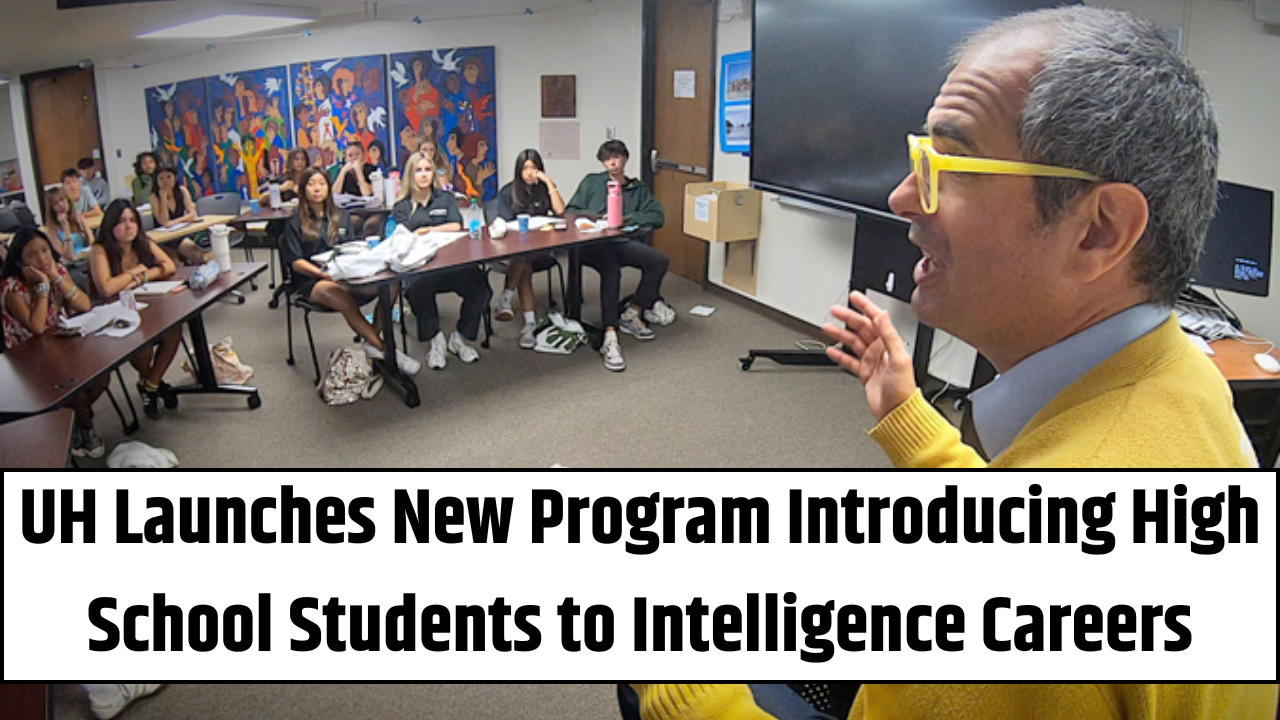
This summer, 30 students from across the islands participated in the Academy for Hawaiʻi Intelligence Studies Summer Program (AHI-SP), a four-week academic experience designed to introduce teens to international relations, global politics, and the foundations of national intelligence. The program is offered through the University of Hawaiʻi at Mānoa’s Department of Political Science within the College of Social Sciences and is the first of its kind in the state.
Running from July 6 to July 29, the program combined online coursework with an intensive in-person residential week on the UH Mānoa campus. Students explored how global power dynamics have evolved since World War II, with a particular focus on the United States’ role in world affairs. Lessons were paired with hands-on learning through simulation exercises, site visits, and networking opportunities with intelligence and defense professionals based in Hawaiʻi.
Program leaders say the initiative aligns closely with workforce development goals in the islands, particularly as the Indo-Pacific region becomes increasingly central to U.S. strategic interests.
“AHI reflects our college’s commitment to preparing students for meaningful careers that serve both Hawaiʻi and the nation,” said Denise Eby Konan, dean of the College of Social Sciences and an economics professor. She emphasized that social science education plays a critical role in intelligence work, helping professionals understand cultures, political systems, and human behavior. According to Konan, Hawaiʻi’s deep connections to the Asia-Pacific region position local students to bring valuable perspectives to the intelligence community.
Building a pathway to future careers
Students who completed the program earned college credit for POLS 120: Introduction to World Politics, a foundational university-level political science course. This class also serves as the entry point to a broader intelligence studies curriculum currently being developed at UH Mānoa.
“This is a major first step in creating a clear academic and workforce pipeline for students interested in intelligence careers,” said Jairus Grove, AHI-SP program director, political science professor, and department chair. He noted that the program is the first in Hawaiʻi to allow high school students to earn college credit specifically tied to a national intelligence pathway.
Grove added that the long-term goal of AHI is to identify and support future leaders from Hawaiʻi who can help navigate the complex political, security, and economic challenges shaping the Pacific region in the decades ahead.
Diverse participation from across the islands
The cohort included juniors and seniors from Hawaiʻi Island, Kauaʻi, Maui, and Oʻahu. More than half of the participants came from neighbor islands, with students representing both public Department of Education schools and charter schools statewide. Participants were required to be Hawaiʻi residents and maintain a minimum cumulative GPA of 2.8.
Many students said the experience broadened their understanding of both global issues and potential career paths.
“It was really exciting to be accepted,” said Wailana Hoʻopai, a senior at Kamehameha Schools Maui. While her initial interest was international relations, she said learning about intelligence work and meeting professionals connected to U.S. Indo-Pacific Command helped her better understand Hawaiʻi’s role in national security.
For Kauaʻi High School senior Talen Koerte, the program opened doors to career options he had not previously considered. “I didn’t realize how many paths political science could lead to, like diplomacy or intelligence work,” he said. “It was eye-opening.”
Beyond academics, students highlighted the value of building relationships with peers from different islands. Kailani Clark, a senior at Kealakehe High School on Hawaiʻi Island, said living and learning alongside students from across the state expanded her perspective.
“Even though the Big Island is large, it can feel small in terms of viewpoint,” Clark said. “Meeting people from other islands and sharing experiences was one of the most meaningful parts of the program.”
Fully funded through public-private partnership
All student expenses—including tuition, fees, airfare, housing, and meals—were covered through the Pacific Intelligence and Innovation Initiative (P3I), a public-private partnership focused on developing a skilled local workforce.
Jennifer Sabas, co-program lead for P3I, said the initiative is designed to prepare Hawaiʻi residents for evolving workforce needs in the Indo-Pacific, with an emphasis on intelligence, cybersecurity, data analytics, and information technology.
P3I works in collaboration with UH Mānoa, UH West Oʻahu, the UH Community Colleges, Chaminade University, and Hawaiʻi DOE high schools. Sabas noted that students from Hawaiʻi bring a strong sense of commitment and service.
“Our students, guardsmen and women, and returning kamaʻāina are ready to step up,” she said. “This is about investing in our people and preparing them to serve at a critical moment for the region and the nation.”