ABSTRACT
With the rapid integration of artificial intelligence (AI) into everyday life, children are increasingly exposed to this concept through multiple channels such as media, education, and digital technologies. How AI is presented through these channels plays a crucial role in shaping students’ perceptions. This study investigates how third- and fourth-grade primary school students perceive artificial intelligence by analysing the metaphors they generate and the drawings they create.
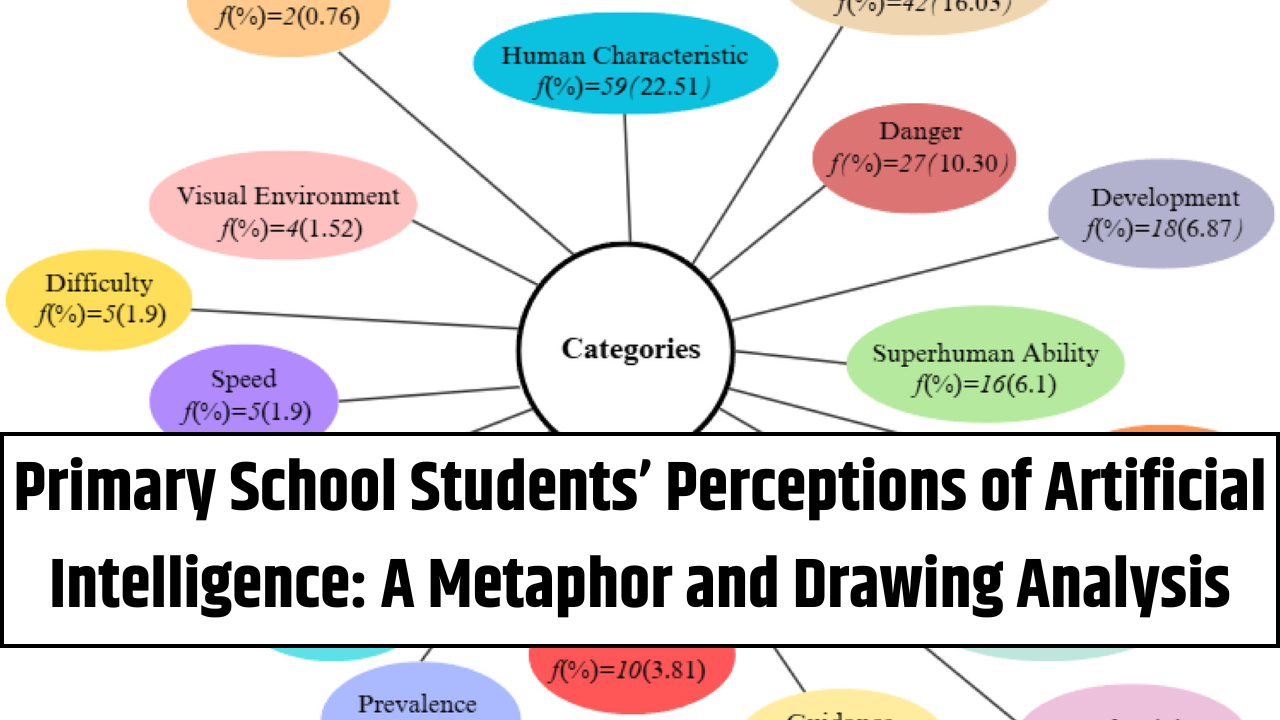
The study was conducted using a phenomenological qualitative research design with the participation of 262 students. Analysis revealed that students produced 100 distinct metaphors, which were grouped into 17 thematic categories, including human-like characteristics, source of information, danger, development, superhuman abilities, service, happiness, productivity, guidance, dependence, pervasiveness, necessity, security, speed, difficulty, virtual environment, and uncertainty. Among these, metaphors related to human-like features, information sources, and danger were most frequently observed. Prominent examples included metaphors such as human, brain, and living being in the humanistic category; teacher, book, and wise person in the information source category; and enemy, weapon, and monster in the danger category.
Drawing analysis produced 37 codes clustered under four main categories: purpose, object, interaction, and environment. Students primarily depicted AI as serving humans, providing information, or offering entertainment. The most common visual representation was a humanoid robot, with strong emphasis on interaction between humans and AI, while environmental context was often left undefined. Based on these findings, implications were discussed in relation to existing literature, and recommendations were proposed for educational practice and future research.
1. Introduction
In contemporary societies, equipping students with competencies such as 21st-century skills (Trilling & Fadel, 2009), metacognitive abilities (Roll & Wylie, 2016), and science-related standards (NGSS, 2013) has become a central educational priority. As a result, learning environments have evolved to align with constructivist approaches that promote student agency, active participation, and knowledge construction (Piaget, 1968; Vygotsky, 1987).
To support these goals, educational institutions have increasingly relied on technological innovations. Since the 1970s, computers have played a key role in automating instruction, managing learning processes, and modelling various systems (Mukhtoraliyevna & Tavakkalovna, 2022). More recently, artificial intelligence—often described as computational systems capable of mimicking human cognitive processes (Baker et al., 2019)—has gained prominence across educational contexts.
AI technologies have advanced rapidly, enabling machines to perform complex tasks such as reasoning, analysing data, and making decisions (Topol, 2019). In education, AI-powered applications include intelligent tutoring systems, adaptive learning platforms, learning analytics, virtual and augmented reality tools, automated feedback systems, and conversational agents (Chen et al., 2020; Yufeia et al., 2020). These systems can personalise learning experiences, support teacher decision-making, and continuously optimise learning environments (Chassignol et al., 2018; Yang & Bai, 2020).
However, the increasing presence of AI also raises important psychological, social, and ethical considerations for students. AI-enhanced environments can influence learners’ well-being, motivation, and emotional states (Huang et al., 2024). Additionally, frequent interaction with AI may affect children’s social relationships, moral reasoning, and sense of agency, particularly when students take on roles resembling “caretakers” of intelligent systems (Caygın & Yavuz, 2020; Sharkey & Sharkey, 2017). These factors highlight the importance of understanding how young learners perceive artificial intelligence.
Although prior research has examined perceptions of AI among university and secondary school students, studies focusing on primary school children remain limited. Given that conceptual understandings begin forming at an early age, neglecting younger learners represents a significant gap. This study addresses this gap by exploring primary school students’ perceptions of AI through metaphors and drawings, offering insight into how children conceptualise this rapidly evolving technology.
2. Literature Review
2.1 Artificial Intelligence
Artificial intelligence has been defined in multiple ways within academic literature. Broadly, AI refers to computational systems designed to perform tasks typically associated with intelligent beings, such as reasoning, learning, and problem-solving (Chiu, 2021; Xia et al., 2022). Other definitions emphasise AI’s ability to operate within specific cultural and demographic contexts (McLean & Osei-Frimpong, 2019) or its capacity to simulate human cognitive behaviour while adapting through experience (Sajja, 2021).
AI encompasses a wide range of subfields, including expert systems, intelligent agents, machine learning, artificial neural networks, deep learning, genetic algorithms, fuzzy logic, intelligent tutoring systems, and natural language processing. Each of these domains contributes to AI’s ability to analyse data, interact with humans, and support decision-making processes (LeCun et al., 2015; Russell & Norvig, 2016; Khurana et al., 2023).
In educational contexts, AI has demonstrated positive effects on student engagement, academic performance, motivation, self-efficacy, and critical thinking skills (Sun & Zhou, 2024; Liu & Wang, 2024; Pertiwi et al., 2024). Teachers also benefit from AI tools that assist with assessment, feedback, and emotional monitoring (Baashar et al., 2022; Daş et al., 2024).
2.2 Metaphors in Educational Research
Metaphors play a vital role in understanding how individuals conceptualise abstract ideas. Rooted in cognitive linguistics, metaphors allow people to interpret unfamiliar concepts by relating them to known experiences (Lakoff & Johnson, 1980). In educational research, metaphors are widely used to reveal students’ implicit beliefs, perceptions, and mental models (Oxford et al., 1998; Kövecses, 2017).
Metaphorical expressions are shaped by cultural, social, and political contexts, meaning that the environment in which learners interact significantly influences the metaphors they create (Charteris-Black, 2004; Refaie, 2003). This makes metaphor analysis particularly valuable for examining perceptions of AI, which is often portrayed in media and popular culture as either a powerful ally or a potential threat to humanity (Hermann, 2023).
2.3 Drawings as a Research Tool
Drawing is an effective method for eliciting children’s thoughts and emotions, especially when verbal expression is limited (Akkus, 2013). Through drawings, students can visually express their understanding, imagination, and beliefs without linguistic constraints (Harman et al., 2015). When combined with student explanations, drawings provide rich qualitative data and strengthen the credibility of research findings (Bessette, 2008).
3. Methodology
3.1 Research Design
This study employed a phenomenological qualitative research design to explore students’ lived experiences and perceptions of artificial intelligence. Phenomenology aims to uncover the essence of a phenomenon as experienced by individuals, making it particularly suitable for examining children’s conceptual understandings (Creswell, 2011; Van Manen, 2016).
3.2 Participants
Participants were selected using criterion sampling. Criteria included being enrolled in the third or fourth grade, having prior exposure to the concept of AI, and receiving parental consent. Of the 419 students initially involved, 262 produced valid metaphors and were included in the final analysis.
3.3 Data Collection
Data were gathered using an open-ended questionnaire that included demographic questions, metaphor prompts (“AI is like… because…”), drawing tasks, and written explanations of drawings. Students were given one class period to complete the tasks to capture their spontaneous perceptions.
3.4 Data Analysis
Content analysis was applied to both metaphor and drawing data following systematic coding, categorisation, and validation procedures. Inter-rater reliability exceeded accepted thresholds, ensuring analytical consistency.
4. Findings
Students most frequently reported learning about AI through the internet, television, school, and robotic coding courses. Metaphor analysis revealed 17 thematic categories, with human-like characteristics, information sources, and danger being most prominent. Drawing analysis supported these findings, showing that students commonly visualised AI as humanoid robots interacting with humans.
5. Discussion
The findings indicate that primary school students largely perceive AI through anthropomorphic lenses, attributing human and superhuman qualities to it. This aligns with previous research suggesting that children associate AI with intelligence, authority, and agency. At the same time, students expressed concerns about AI’s potential risks, reflecting narratives commonly portrayed in media.
Despite these concerns, students also recognised AI’s benefits, particularly in terms of learning, productivity, entertainment, and guidance. These mixed perceptions suggest a nuanced understanding of AI that incorporates both optimism and caution.
6. Conclusion and Recommendations
This study demonstrates that primary school students hold multifaceted perceptions of artificial intelligence, shaped by media exposure, educational experiences, and societal narratives. To foster balanced and informed perceptions, educators should introduce age-appropriate AI literacy activities that emphasise both opportunities and ethical considerations. Future research may explore how structured AI education influences students’ critical thinking, creativity, and ethical awareness.
7. Limitations
The study is limited by its sample size and geographic scope. Future studies could expand the participant pool and explore cross-cultural differences in children’s perceptions of AI.