Thirty years after its founding, Mercyhurst University’s Intelligence Studies program has grown into one of the most respected and influential intelligence education models in the United States—a development that still amazes its creator, Bob Heibel.
“It’s just wonderful sometimes,” said Heibel, an Erie native. “Some schools have certain specialties they deal in, but when Mercyhurst is mentioned, it’s intelligence. Because of that, it’s become the model.”
Heibel, a 25-year veteran of the FBI and former deputy chief of counterterrorism, launched Mercyhurst’s Research/Intelligence Analyst Program (RIAP) in 1992, making it the first intelligence degree program of its kind in the nation.
Also Read – Bachelor’s Degree in Global Security & Intelligence Studies: Career Path Guide
From Pioneering Program to National Leader
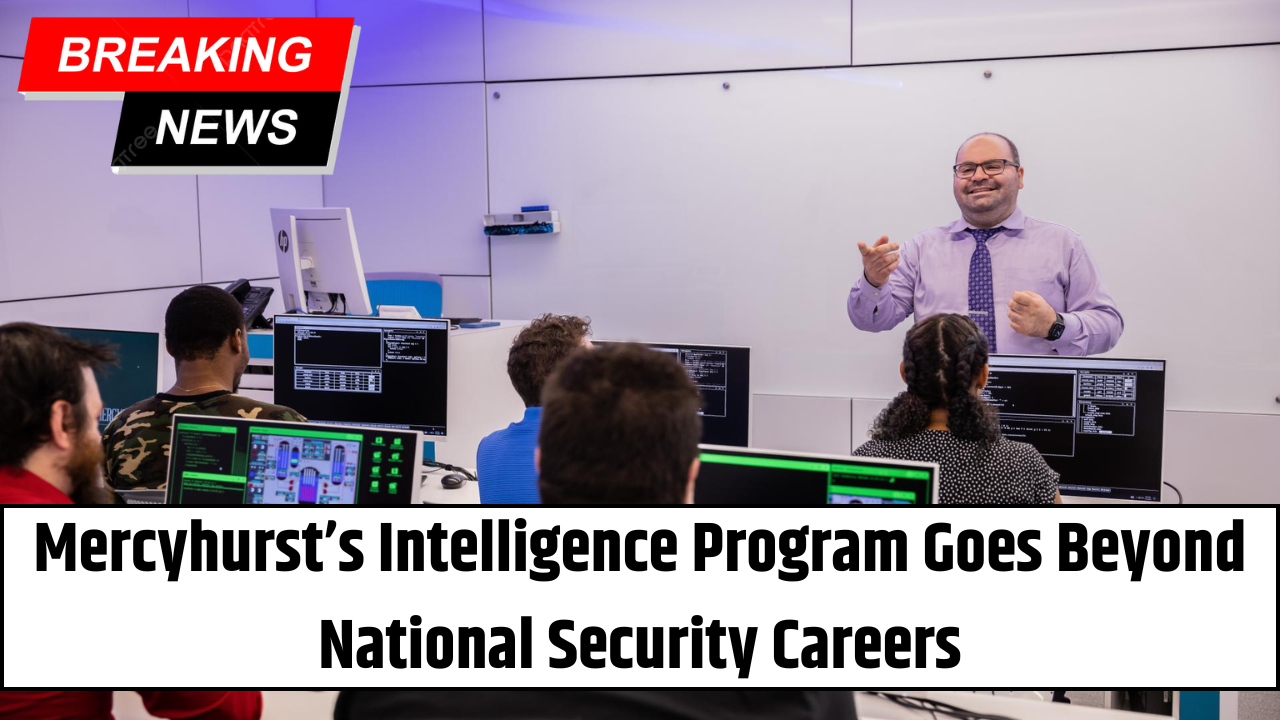
Today, Mercyhurst’s Intelligence Studies program—housed within the Ridge College of Intelligence Studies and Applied Sciences—is among the largest and oldest intelligence programs in the country. The program prepares entry-level analysts for careers across government and the private sector, including law enforcement, national security, the military, business, and corporate risk analysis.
From the beginning, Heibel insisted the curriculum focus on applied skills, blending classroom theory with real-world practice—an approach that remains central to the program.
“That commitment to applied skills and national security is what allows our students to be off and running,” said Lindy Smart, executive director of the Intelligence Studies program. “It’s a feedback loop—we work with professionals in the field, they help our students find jobs, and that keeps our curriculum current and relevant.”
Adapting to a Changing Intelligence Landscape
As the intelligence field evolves, Mercyhurst has expanded its focus beyond traditional government roles to include cross-sector applications.
“What it’s really about is going back to our origins—human intelligence, geographic intelligence, open-source intelligence—and making sure our analysts are well trained in those areas,” Smart said. “Those skills allow them to move from national security to the private sector, or into areas like HR, strategic finance, or corporate security.”
Course offerings increasingly reflect cross-functional intelligence teams, showing how national security principles apply to global business, emerging threats, and major world events.
From Classroom to Global Security Operations
For Seth Bowman, a senior studying business and competitive intelligence, the program’s versatility led directly to a job at Pfizer’s Global Security Operations Center (GSOC) in New York City.
Also Read – National AI Research Resource Pilot: What It Means for Innovation
Bowman began as an intern in January 2022, uncertain about his career direction. That quickly changed when Russia invaded Ukraine just weeks into his placement.
“There was suddenly so much to do,” Bowman said. “I found myself working directly alongside analysts, not just supporting them.”
Bowman analyzed global geopolitical conditions and market-specific risks—work that mirrored what he had been learning in class.
“A lot of the reports were exactly the same things we were doing in class,” he said. “Because they know the skill set we inherit through the program, they were able to bring us fully onto the team.”
Smart said Bowman’s experience reflects the program’s broader goal: preparing students to apply intelligence skills across non-traditional fields.
“Our students aren’t lining up for just one agency or company,” she said. “Those fundamental skills let them move more easily across sectors while still maintaining a strong commitment to national security.”
Staying Competitive Through Alumni and Industry Partnerships
With an estimated 100 universities now offering intelligence-related programs, Mercyhurst continues to stand out through curriculum diversification and strong professional networks.
The program’s 1,800-member alumni network—which includes individuals working at the highest levels of government and industry—has become a major asset. In fall semester, Smart launched a formal mentorship program connecting alumni with current students.
“The alumni keep asking, ‘How can I help?’” she said. “Sometimes it’s as simple as teaching students how to build relationships beyond LinkedIn—how to set up calls, how to keep conversations going, how to grow professionally.”
Smart believes Mercyhurst’s decades-long partnerships with Fortune 500 companies, law enforcement agencies, and government organizations give graduates a lasting advantage.
“Our students leave with two to three years of experience, a developed network, and a transferable skill set,” she said. “That positions them for long-term success, even if they decide to change fields.”
Also Read – AI Week Spotlights Student and Faculty Research on Artificial Intelligence
Shaping the Future of Intelligence Education
As the program looks toward its next 30 years, Smart and Heibel share a vision of continuing to shape the intelligence industry—not just at Mercyhurst, but nationally.
“One thing we never did was say, ‘This is ours, you can’t have it,’” Heibel said. “From the beginning, we invited other schools in and helped them start programs. That openness is one of our greatest strengths.”
Three decades after its launch, Mercyhurst’s Intelligence Studies program remains rooted in its founding principles—collaboration, applied learning, and adaptability—while continuing to influence the future of intelligence education across the country.