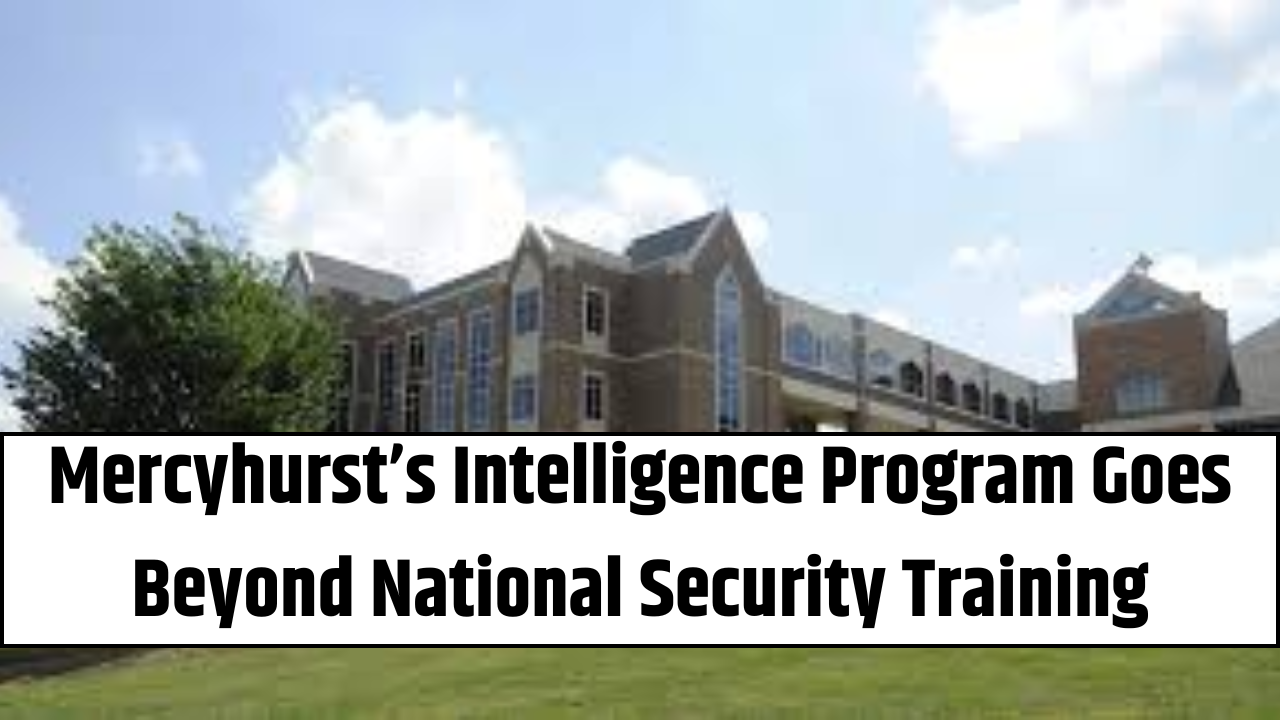
Three decades after its launch, the Intelligence Studies program at Mercyhurst University continues to shape how intelligence education is taught across the country—an outcome that still surprises its founder, Bob Heibel.
Heibel, an Erie native and a former senior leader with the Federal Bureau of Investigation, established the Research/Intelligence Analyst Program (RIAP) in 1992 after more than two decades working in federal law enforcement and counterterrorism. At the time, no U.S. university offered a dedicated intelligence degree.
“We wanted students who were curious about the world—history, politics, global events—and who wanted to turn that curiosity into a career,” Heibel said. The first class enrolled just 14 students, but from the start, the emphasis was on quality and practical ability rather than size.
From a single program to a national model
What began as RIAP has grown into one of the country’s oldest and largest intelligence programs, now housed within Mercyhurst’s Ridge College of Intelligence Studies and Applied Sciences. Graduates regularly move into roles across government, national security, law enforcement, the military, and a growing number of private-sector fields.
A defining feature of the program has always been its applied focus—teaching students how to analyze real-world problems, not just study theory. That principle remains central today, according to Lindy Smart, executive director of Intelligence Studies.
“Our goal is to make sure students can step into professional environments and contribute immediately,” Smart said. “We work closely with people already in the field, and that feedback directly shapes what we teach.”
Expanding intelligence beyond national security
As the intelligence profession has evolved, so has Mercyhurst’s curriculum. While national security remains a core pillar, the program increasingly emphasizes transferable skills such as open-source intelligence, human intelligence, and geographic analysis—tools that apply across industries.
“It’s about going back to fundamentals,” Smart explained. “If students understand how to analyze information, assess risk, and communicate findings, they can move between sectors more easily—from government to business, or even into areas like finance or human resources.”
That flexibility is becoming increasingly important as intelligence skills are adopted by corporations, nonprofits, and global organizations navigating complex political and economic environments.
Real-world experience, real-world outcomes
For students like Seth Bowman, that adaptability paid off quickly. As a senior concentrating on business and competitive intelligence, Bowman secured an internship—and later a full-time position—at Pfizer’s Global Security Operations Center in New York City.
Initially unsure of his career direction, Bowman’s path shifted dramatically when Russia invaded Ukraine during his internship.
“Suddenly, there was a flood of geopolitical issues affecting markets around the world,” he said. “The work we were doing at Pfizer mirrored exactly what we were learning in class.”
Rather than observing from the sidelines, Bowman worked alongside professional analysts, producing reports and assessments that directly supported corporate decision-making.
“They trusted us because they knew what Mercyhurst students are trained to do,” he said.
Staying competitive in a crowded field
Today, an estimated 100 universities worldwide offer intelligence-related degrees, but Mercyhurst maintains its edge through deep industry connections and a strong alumni network. More than 1,800 graduates—many in senior government and private-sector roles—remain actively engaged with the program.
To strengthen those ties, Smart recently launched a formal mentorship initiative, pairing students with alumni for career guidance and professional development.
“Alumni are constantly asking how they can help,” she said. “This gives students a clearer path to build relationships that go beyond a single LinkedIn message.”
Looking ahead to the next 30 years
As the program enters its fourth decade, its leaders remain focused not just on keeping pace with the intelligence field, but on shaping its future. That collaborative mindset traces back to Heibel’s original vision.
“We never treated this as something to protect or keep to ourselves,” he said. “From the beginning, we invited other schools in and shared what we were doing.”
That openness, combined with a commitment to practical skills and adaptability, has helped Mercyhurst’s Intelligence Studies program move from a bold experiment to a benchmark for intelligence education—one that continues to influence how analysts are trained well beyond campus walls.