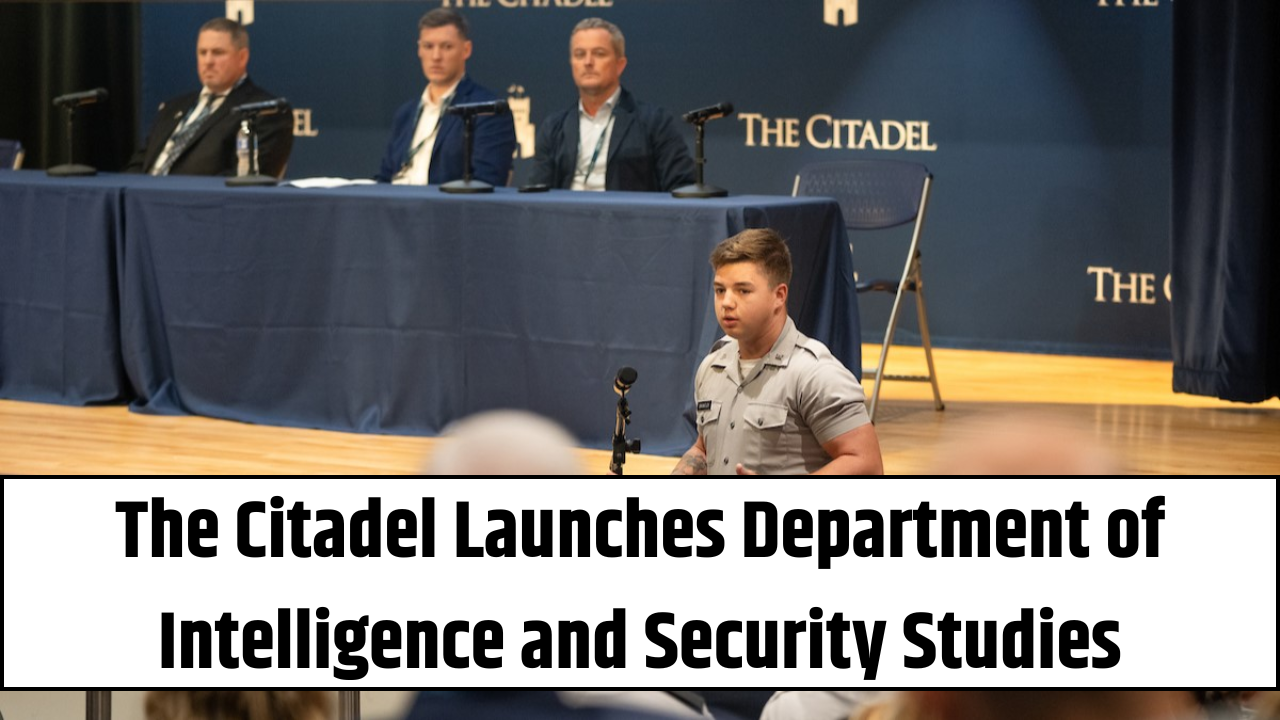
Curiosity may be the most important qualification for students interested in The Citadel’s newest academic offering — a Bachelor of Arts in Intelligence and Security Studies.
“Insatiable curiosity. If you don’t have that, you will not be a successful intelligence officer,” said Lt. Col. Mike Brady, a professor in the department.
As the South Carolina military college marks its 175th anniversary, The Citadel continues to expand its academic footprint to reflect the demands of a post-9/11 world. In recent years, the institution introduced an undergraduate minor in cybersecurity in 2013, followed by a graduate certificate in cybersecurity in 2014. The new intelligence and security studies degree builds on that foundation.
Students enrolled in the program are required to study cybersecurity fundamentals alongside coursework in psychology, data analysis, and professional writing. The degree offers five concentration options: Military Intelligence, Chinese Area Studies, Counterterrorism, Business Intelligence, and General Intelligence.
Brady, a 1990 Citadel graduate, said the program aligns with the school’s long-standing mission while acknowledging the need to adapt.
“I don’t know if it redefines the institution,” he said. “Some of those core principles of the school are always going to be there. We want to create disciplined and principled leaders. But as we look at intelligence and security studies, we certainly have to adapt to the world around us.”
The bachelor’s program launched quietly this fall after receiving state approval in June. Despite limited promotion, it has already attracted 58 students, with several upperclassmen expressing interest in switching majors.
Faculty members bring extensive real-world experience to the classroom. Brady’s U.S. Army career included long-range surveillance, interrogation, and predictive analysis, and he served as director of the Presidential Emergency Operations Center on Sept. 11, 2001.
The program is led by Carl Jensen, a former FBI agent with 22 years of experience as both a forensic examiner and field agent. Another faculty member, Melissa Graves, specializes in research examining how intelligence leaders have interacted with U.S. presidents.
Coursework incorporates real-time global issues, including cyberattacks and escalating nuclear tensions in North Korea. Ethical decision-making is a central theme throughout the curriculum, according to Graves.
“The temptation might be to tell a policymaker what they want to hear or to let your own political viewpoints skew how you interpret information,” she said. “Those are things we actively address and work to overcome.”
Among the first freshmen in the program is Brian Allen, a 23-year-old Virginia native and member of the United States Marine Corps Reserve. Allen initially planned to pursue a business degree but said the intelligence program better aligned with his interests and military experience.
“There’s a lot of good knowledge I’m learning that carries over to what I do in the Marine Corps,” Allen said. “In the Intro to Intelligence class, ethics comes up almost every day. We usually spend at least 15 minutes talking about it.”
The new degree reflects The Citadel’s evolving academic mission — one that blends tradition with the modern demands of intelligence, security, and ethical leadership.