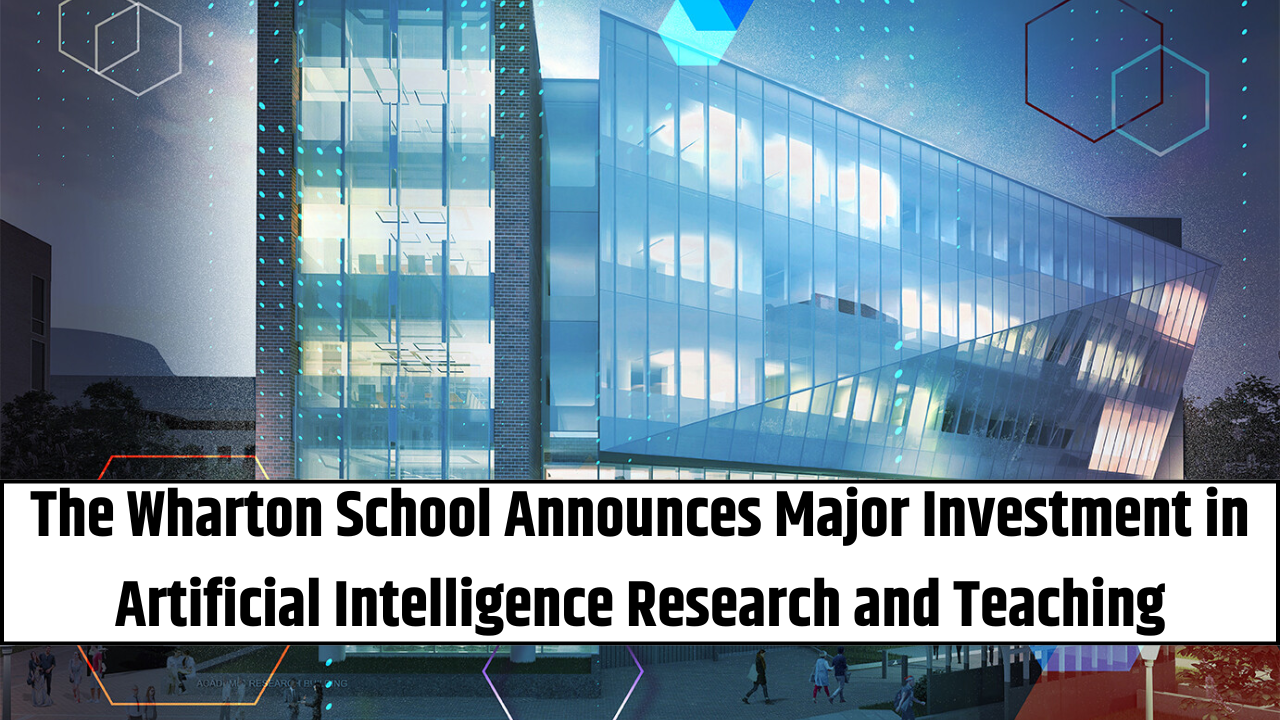
The Wharton School at the University of Pennsylvania has unveiled a significant new initiative aimed at dramatically expanding its leadership in artificial intelligence and data science education. The Wharton AI & Analytics Initiative represents a major investment in research, curriculum development, and industry collaboration, positioning the school at the forefront of AI-driven business education.
At the core of the initiative is a comprehensive, interdisciplinary strategy designed to integrate artificial intelligence across Wharton’s academic departments and programs. The effort will support new research, reimagined classroom instruction, partnerships with industry leaders, and the development of open-source tools intended to influence how generative AI evolves in business and society.
One of the most notable components of the announcement is Wharton’s plan to provide ChatGPT Enterprise licenses to all full-time and executive MBA students beginning this fall. The move marks the first time a business school has partnered directly with OpenAI at this scale, giving students direct access to advanced generative AI tools as part of their academic experience.
University of Pennsylvania Interim President J. Larry Jameson emphasized the urgency of proactive leadership in the AI era, noting that artificial intelligence is rapidly reshaping how people work, learn, and make decisions. He described the initiative as a strategic step that aligns with Penn’s broader mission to address global challenges through innovation and research.
Wharton Dean Erika James highlighted the responsibility business schools have in shaping the practical and ethical use of artificial intelligence. She stressed that as AI increasingly influences every sector of the economy, institutions like Wharton must provide evidence-based insights into how these technologies can be deployed responsibly and effectively. According to James, Wharton’s long-standing strength in analytics makes it uniquely positioned to study AI’s broad societal and economic implications.
To support the initiative, Wharton is launching two new funding programs. The Wharton AI Research Fund will provide faculty with resources to explore how AI intersects with modern business models, industries, and global markets. In parallel, an Education Innovation Fund will support faculty as they redesign courses and teaching methods to incorporate AI-powered tools and concepts into the classroom.
The initiative builds on existing work conducted through centers such as AI at Wharton and the Mack Institute for Innovation Management. Faculty from all ten of Wharton’s academic departments will be encouraged to collaborate on research examining AI’s role in areas including finance, marketing, entrepreneurship, health care, workforce productivity, and ethical accountability.
Leadership of the Wharton AI & Analytics Initiative has been entrusted to Eric Bradlow, Vice Dean for AI & Analytics and a professor whose expertise spans marketing, statistics, economics, and education. Bradlow has extensive experience connecting academic research with real-world business applications and previously helped establish Wharton’s first data science center focused on business.
Bradlow said the initiative reflects Wharton’s ambition to become the leading global hub for AI-focused business education and research. He noted that the school intends not only to generate new scholarship but also to share insights broadly with industry, policymakers, and educators.
In addition, Wharton is developing an open-source platform that will allow for rapid experimentation with generative AI tools. The platform is designed to support the creation of AI prototypes that enhance learning, decision-making, and organizational effectiveness, while also addressing the potential risks associated with emerging technologies.
Deputy Dean Nancy Rothbard underscored the growing necessity of AI literacy, stating that understanding AI’s impact on business decision-making is no longer optional for professionals seeking to remain competitive. She said the initiative reflects Wharton’s commitment to preparing students and organizations for the realities of an AI-driven economy.
More information about the Wharton AI & Analytics Initiative can be found on the school’s official website.