CHAMPAIGN, Ill. — Scientists at the University of Illinois Urbana-Champaign will lead a new national Artificial Intelligence Research Institute aimed at transforming how young people learn science, technology, engineering and math (STEM).
The National Science Foundation announced it will award $20 million over five years to establish the Inclusive and Intelligent Technologies for Education (INVITE) Institute, which will be based in the university’s College of Education. Approximately $8 million of the funding will go directly to the University of Illinois, supporting eight faculty members across four departments.
The INVITE Institute will focus on developing AI-powered learning technologies that adapt to students’ needs by tracking and fostering noncognitive skills—such as persistence, resilience and collaboration—that research has shown are critical to academic success.
National collaboration on AI and learning
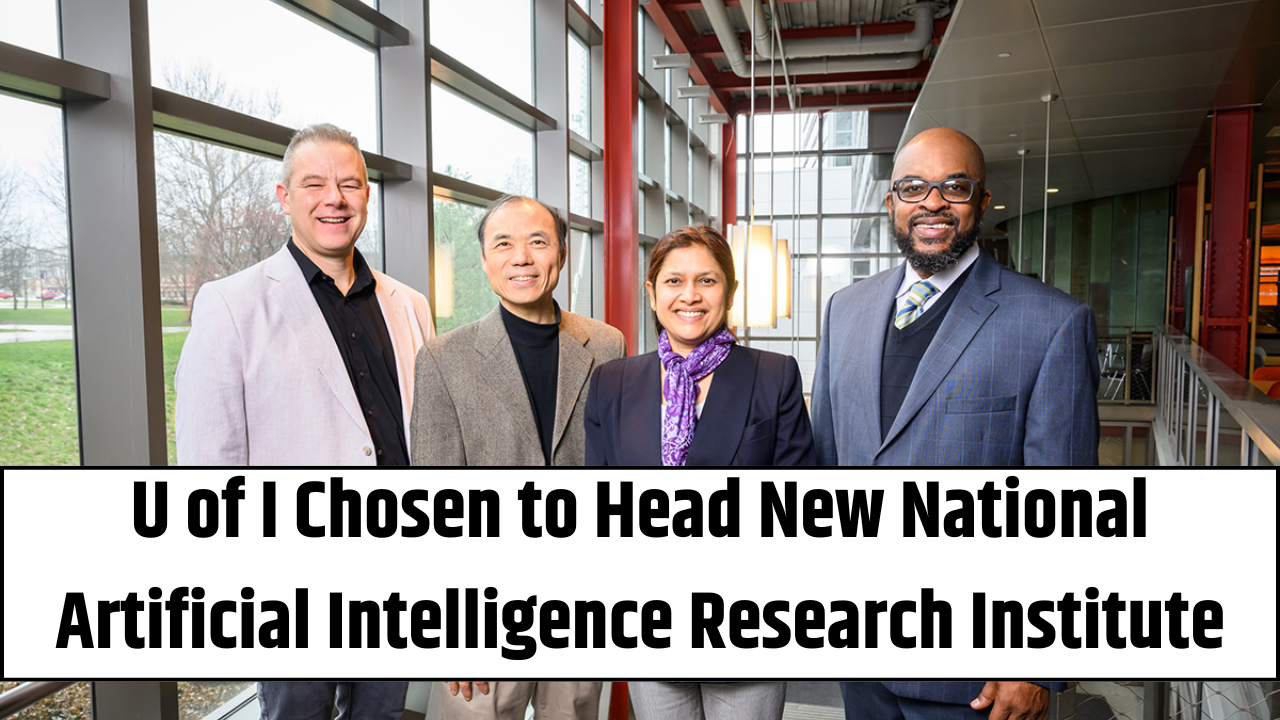
The institute will be led by H. Chad Lane, a professor of educational psychology, computer science, and curriculum and instruction at the University of Illinois. The leadership team also includes researchers from the nonprofit Educational Testing Service, Temple University, and the University of Florida.
“The NSF’s support enables us to pursue transformative interdisciplinary research in AI, learning sciences and psychology,” Lane said. “It also allows us to scale outreach and AI education efforts nationally so we can reach students and teachers where they are.”
Lane’s research blends artificial intelligence with techniques from the entertainment industry to create engaging educational experiences that promote STEM learning.
Expanding access to STEM education
A core mission of INVITE is to broaden STEM engagement among historically marginalized groups, particularly students in prekindergarten through 12th grade. By investigating emerging AI techniques and building intelligent learning environments, the institute aims to reduce barriers faced by girls, students of color and other underrepresented populations.
“We know that a strong foundation in STEM is one of the most important predictors of long-term educational and career success,” said Robert J. Jones, chancellor of the University of Illinois Urbana-Champaign. “Harnessing AI to deliver accessible, high-quality learning tools for underserved students offers a transformational opportunity for our nation’s education system.”
Over the next five years, INVITE platforms are expected to reach more than 96,000 students across 24 school districts, providing both formal and informal learning opportunities. Partner schools, universities, community organizations and museums will emphasize hands-on, real-world problem-solving activities.
Responsible AI and large-scale data
INVITE researchers will use advanced computing resources from the College of Education, the Grainger College of Engineering, and partner institutions to collect large-scale datasets from diverse student populations. These datasets will support the creation of AI systems that are socially aware and responsive to students’ interests, cultural contexts and learning behaviors.
“One of the biggest barriers to progress in AI for education is the lack of shareable K–12 datasets,” said Cheng-Xiang Zhai, co-principal investigator and professor of engineering at the University of Illinois. “We aim to address that gap by collecting rich, representative data that can drive advances in fair and robust machine learning and socially intelligent systems.”
Zhai will co-direct the institute’s research alongside Diego Zapata-Rivera, a Distinguished Presidential Appointee at Educational Testing Service.
Broad leadership and national impact
The INVITE leadership team also includes Kristy Boyer, managing director and professor at the University of Florida, and Jamie Payton, director of community engagement and outreach at Temple University. Rodney Hopson, a University of Illinois professor of educational psychology, will serve as evaluation director.
Additional University of Illinois faculty contributing to the project include Suma Bhat, Jina Kang, Robb Lindgren, Luc Paquette, Colleen Lewis, and Jessica Gladstone.
INVITE is one of seven national AI Institutes launched this year and marks the third NSF-led AI Institute directed by University of Illinois scientists since the program began in 2020.
Funding partners for the NSF-led initiative include the U.S. Departments of Defense, Education, Homeland Security and Agriculture; the National Institute of Standards and Technology; and IBM.
Together, INVITE leaders say the institute represents a major step toward using artificial intelligence responsibly to ensure inclusive, high-quality education for students nationwide.